


This Guy Was So Smart It Sounds Unreal

Some people change a field.
A rare few change the way fields themselves are built.
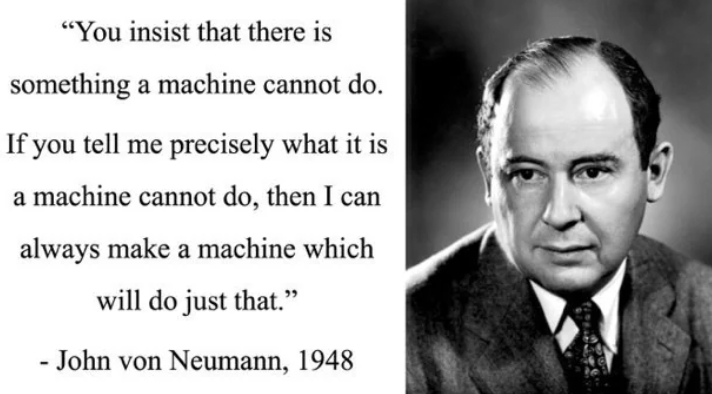
John von Neumann belonged to the second category.
More than half a century after his death, his ideas still quietly power the devices we use every day from laptops and smartphones to large-scale computing systems. In an era obsessed with artificial intelligence, it is worth revisiting a thinker who laid much of the conceptual groundwork for the digital age long before the term even existed.
A Genius So Extreme It Became a Problem
Born in 1903 into a wealthy Jewish family in Budapest, von Neumann’s intellectual abilities were extraordinary even by prodigy standards.
As a child, he could perform complex mental calculations with ease, absorb books after a single reading, and converse fluently in multiple languages. By the time most children were learning basic arithmetic, he was already comfortable with advanced mathematics.
Ironically, his talent created practical problems. Private tutors were unwilling to teach him—not because of pay, but because they felt unqualified. Even schools struggled to keep him engaged, eventually admitting that they simply had nothing left to offer him.
Brilliance, in this case, arrived faster than the educational system could adapt.
Between Idealism and Reality
Despite his love for mathematics, von Neumann’s path was not guided by passion alone. His father, a banker, insisted that his son pursue something “practical.” Mathematics, he believed, was intellectually elegant but economically risky.
The compromise was chemistry.
Officially, von Neumann studied chemistry at the University of Berlin. Unofficially, he studied everything else—simultaneously attending ETH Zurich and completing advanced mathematical work at the University of Budapest.
What stands out is not just his capacity, but his flexibility. He did not treat disciplines as fixed identities. For him, they were tools, chosen based on the problem at hand.
Redefining What a Computer Is
Von Neumann’s influence spans many domains, but his most enduring legacy lies in computing.
In 1945, he co-authored a report that would later become one of the most influential documents in computer science. Rather than focusing on individual calculations, the report proposed a structure for machines that could store data and instructions together, operate using binary logic, and switch tasks flexibly.
This conceptual model—now known as the von Neumann architecture still underpins modern computers.
In simple terms, while others were asking how to compute faster, von Neumann asked a deeper question:
What should a machine look like if we want it to compute anything at all?
That shift—from solving tasks to designing systems—is what made his work timeless.
Thinking in Systems, Not Tricks
A helpful way to understand von Neumann’s mindset is this:
Most people focus on improving individual actions.
Von Neumann focused on redesigning the environment in which actions happen.
It is the difference between optimizing a recipe and inventing the kitchen.
This habit of thinking—abstracting away from surface problems to underlying structures—is precisely why his ideas scale across decades and technologies.
A Life Cut Short, an Influence That Wasn’t
Von Neumann died of cancer in 1957 at the age of 53. Even in his final months, he was thinking about the relationship between machines and the human brain. His unfinished notes were later published as The Computer and the Brain, a slim but provocative reflection that feels surprisingly modern in today’s AI-driven world.
One cannot help but wonder how he might have shaped the development of artificial intelligence had he lived longer. But speculation aside, his influence is already embedded deeply enough that we encounter it daily—often without realizing it.
Why von Neumann Still Matters Today
In an age of rapid technological change, von Neumann offers a valuable counterpoint to today’s obsession with tools and trends.
He reminds us that:
- Mastery is not about knowing one domain deeply, but about knowing how domains connect
- Long-term impact comes from designing systems, not just improving techniques
- Intelligence is most powerful when paired with adaptability
These lessons feel especially relevant in a world where AI tools evolve faster than any single skill can keep up.
A Quiet Lesson for the Modern Technologist
Von Neumann was a once-in-a-generation intellect. Most of us will never match his raw ability. But his approach to thinking is far more accessible than his genius.
He paid attention to structure.
He refused to be confined by labels.
And he chose problems based on importance, not tradition.
In a time when technology moves quickly and certainty is rare, that mindset may be his most valuable legacy of all.