

Drone Food Delivery Explained: How Hot Meals Reach Remote Homes

For people living in cities, food delivery has become almost boring.
Opening an app, tapping a few buttons, and waiting for the doorbell now feels routine rather than exciting.
Life looks very different, however, if you live on an island, a peninsula, or anywhere that’s “not far, but not convenient.” In those places, delivery isn’t late it simply doesn’t exist.
That gap is exactly where drones step in. Rather than acting as sci-fi toys, they are being tested as a practical solution to a very human problem: people who want hot food, even when they live off the map.
This Isn’t a Tech Fantasy. It’s a Geography Problem.
To understand why drones matter, geography matters first.
Across Sweden, Norway, and Finland, there are nearly 700,000 islands. While this makes the region breathtaking, it also makes traditional delivery services extremely limited.
In many cases, residents live only a few miles from a city and can still reach it by car, bus, or ferry. Yet once a delivery app opens, the screen shows nothing but empty space.
As one drone startup founder explained it, white squares on the map mean “delivery available,” while black squares quietly say, “sorry, you don’t exist.”
Unfortunately, those black squares are home to tens of thousands of people who also enjoy burgers and fries. Shocking, right?
When a Burger Arrives Like a UFO
Faced with this reality, a Norwegian startup called Aviant chose a different approach.
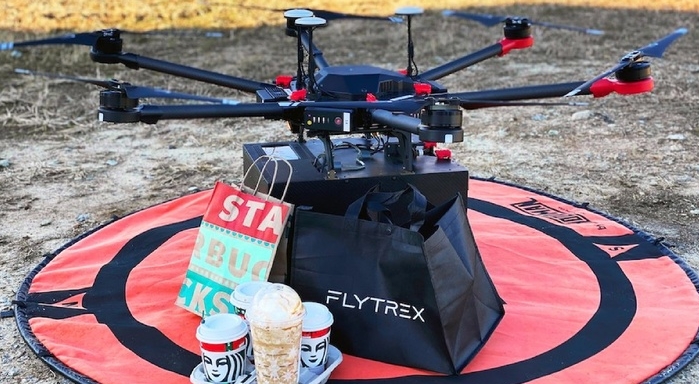
Instead of hiring more drivers, the company put drones in the air. Near Stockholm, drones now fly straight from restaurants to nearby homes, carrying freshly made burgers along the shortest possible route.
For many residents, the first delivery didn’t feel like ordering food at all. Neighbors were called outside, grandparents were invited to watch, and the moment felt closer to spotting a UFO than receiving dinner.
That excitement, however, faded quickly when the fries showed up.
Let’s Be Honest: The Fries Were Terrible at First
Flying food turns out to be much harder than flying cameras.
Fries, especially, are unforgiving. Once they lose their crunch, there is no redemption arc.
Early tests proved this painfully well. Although drones moved fast, the fries arrived soft, sad, and clearly questioning their life choices.
Eventually, the team realized the issue wasn’t the drone itself it was heat. After redesigning insulation containers again and again, they finally managed to keep food hot for about ten minutes, even during Nordic winters.
This may sound like a small detail, but it decides everything.
Cold fries don’t ruin a demo.
Consistently cold fries ruin a business.
“Why Not Just Use Cars?” Because Math.
At this point, a fair question usually comes up: why not just use cars?
On paper, roads exist and vehicles work. In reality, geography quickly ruins the plan. In coastal or rural areas, a four-mile straight line often turns into a thirty mile drive.
As a result, fuel costs rise, delivery times stretch, profits disappear, and drivers lose motivation.
By contrast, drones ignore all of that. They fly straight, avoid traffic, skip detours, and never ask about overtime.
Where Drones Actually Make Sense (And Where They Don’t)
To make things clearer, this is the comparison that really matters:
| Delivery Environment | Human Drivers | Drones |
|---|---|---|
| Dense city centers | Excellent | Terrible |
| Suburbs | Good | Meh |
| Islands & peninsulas | Painful | Excellent |
| Mountains & rural areas | Expensive | Surprisingly good |
| Bad weather days | Annoying | Sometimes grounded |
Ironically, the more remote a place is, the better drones tend to perform.
Cities are crowded, regulated, and unpredictable. Remote areas, on the other hand, are quiet, open, and consistent—almost designed for flying robots.
The Uncomfortable Truth: Selling Burgers Alone Won’t Pay the Bills
Despite the promise, there is an uncomfortable reality behind most drone delivery projects.
Over the past few years, many attempts have failed not because drones didn’t work, but because the business math didn’t.
When food is the only service, distances stay long, order volumes stay low, and customers can’t absorb high delivery fees.
Because of this, companies are shifting strategies. Drones now deliver mail, medical supplies, groceries, and packages. Food deliveries happen in between, when drones would otherwise be idle.
Put simply, a drone needs a full-time job, not a side hustle.
This Is Happening Beyond Scandinavia
Importantly, this experiment is not limited to the Nordic region.
In the UK, drones have been tested for mail delivery and school meals.
In Germany, rural supply deliveries have been trialed.
Meanwhile, in parts of China, drones already deliver hot meals to elderly residents in mountainous areas.
Across these examples, one pattern keeps repeating: early success usually depends on government or institutional support. Pure startup magic, at least for now, rarely survives on its own.
So… Will Drone Food Delivery Ever Go Mainstream?
The short answer is no.
The longer answer is that it doesn’t need to.
Drones won’t replace delivery riders in cities, nor should they try. Instead, they exist for places where riders don’t or simply can’t operate.
For city dwellers, drone delivery is a novelty.
For island residents, it’s a miracle with propellers.
The Real Point (And This Matters)
Ultimately, drone food delivery isn’t about futuristic gadgets or showing off technology.
At its core, it asks a very simple question:
When traditional delivery fails, do people still get to eat something hot?
If technology can answer that without hype, without drama, and without turning fries into soggy regret then it isn’t a gimmick.
It’s just good engineering doing something genuinely useful.
And honestly, that’s the best kind of tech story.